Thursday, November 14, 2019
Maui ; Haleakala

Mid-way through our stay on Oahu, we flew across to Maui for a couple of days. Flying out of Honolulu to other islands you sometimes get great views of the Oahu coast. Mum took lots of photos on the way and despite the dirty windows of the aircraft she got some good ones. Here's one of Diamond Head and suburbs between it and the Koolau range. If you click on the image to get a larger zoom, you may see the lighthouse (on the coast, mid-image) and two of the old gun sites (higher up to the right). Maui is actually 2 shield volcanoes (classed as dormant) joined by a low plain. In the second photo you can see Haleakala shield volcano, a wide rounded mountain rising 10,020ft. There were 2 locations the Oldies wanted to see, Lahaina the old capital of Hawaii, and Haleakala Observatory. Being astronomers, their first target was the observatory. You can just see the white domes of the observatory on the closest volcano, above the cloud. The observatory is 10,000ft above sea level and is the forth-highest observatory in the world. The drive to the summit of Haleakala (House of the Sun) is steep in places and has great views over the island. We were above the cloud while we were there so the view below the summit was not visible, but on a clear day there are spectacular views of the crater and cinder cones of the volcano. The domes in the images house telescopes of the University of Hawaii, the USAF Space Surveillance Complex, and overseas observatories. The largest dome will house the 4m Daniel K Inouye solar telescope, due to be completed next year. Daniel Inouye was a Hawaiian war hero; the Honolulu international airport is named after him. The lower slopes of the volcanoes have some spectacular scenery, lava slopes and canyons. We stayed at the Four Seasons Resort, a great spot to relax on the lanai, sipping cocktails and watching spectacular sunsets.
Labels: astronomy, Hawaii, lighthouse, telescopes
Monday, November 30, 2015
The Grand Old Dish

The iconic radio telescope at Parkes is probably known to most people from its central role in the movie "The Dish". Well, the movie is almost accurate, just a few very small changes to history which those who were astronomers at the time can tell you about. Dad was a very junior astronomer then, but he gets a giggle or two watching the movie. Well, the telescope looks just like it does in the movie, apart from a new focus cabin (that's the white cube at the top of the three legs). Dad used the telescope for several research programs and has climbed all over, under and through the structure. Over the years the control desk was upgraded several times. The 1960's control set was resurrected for the movie. It was the set that Dad learned to drive the telescope with and he was quite nostalgic seeing it on display in the visitors centre. Yes, has actually played cricket on the dish, like in the movie, but that was decades ago and it is not allowed now. And just in case you want to see the Town Hall shown in the movie, that is actually in Forbes, the next town south of Parkes.
Labels: astronomy, New South Wales, telescopes
Friday, November 13, 2015
Where Dad Worked

We are just back from a 4-day road trip to two of the places where Dad used to work before he became a retired astronomer. The top photos are of Siding Spring Observatory (SSO), in the Warrumbungle Mountains of New South Wales. Dad was based at Mt Stromlo Observatory, near Canberra, but most of his research observations were made using telescopes here. In fact, he helped commission 2 of them, the big one in the square building and the small one on the left of the second image. The small one is a 24" diameter one that was specially designed to measure magnetic fields in space and Dad's team were the first to map the field of our Milky Way galaxy (MW) and the Magellanic Clouds (MC) using this telescope way back in the 1970s. The big one is a 2.3m that went into operation in 1984 and Dad made the first science observations with it. The team he was part of used it to work out how the MW and the MC were interfering with other, and to measure the large-scale structure of the Universe. The building shows signs of the bushfire that hit SSO in Jan 2013. The telescopes survived with some repairable heat and smoke damage. Dad's favourite telescope was a 40" that was sold just after he retired, and he also used the big 4m one that you can see in the background of the second image. The last 2 photos are the famous "Dish" at Parkes in central NSW. Most people know it from the movie, but Dad used it for just about all of his projects. The little dish in the background was also important. His group used it to map the Magellanic Stream, the first clue that the Milky Way and the Magellanic Clouds are an interacting system. Mum has helped with some projects at SSO as well, but in the days before me. I am actually quite proud of my clever Oldies, but I'm not going to tell them yet, and it was great to visit these places with them.
Labels: astronomy, Canberra, New South Wales, telescopes
Tuesday, October 20, 2015
Top Telescopes

One of the highlights of our trip to Hawaii, back in October 2013, was the visit to Mauna Kea Observatory. This huge collection of telescopes is at the top of the tallest mountain in the world, measured from its base on the sea floor to the summit. The mountain is an old volcano, hopefully extinct. It should be OK, because the Hawaiian islands are drifting north over a hot spot in the Earth's crust, and have been formed when the hot spot is volcanically active. Hawaii, the big island, is still growing as lava is still flowing from the vents on Mauna Loa, the mountain to the south of the observatory. You can see the results of old eruptions as you drive up the road. The landscape is what you could imagine the Moon or Mars looking like. I had a bit of trouble seeing things at the top because the Oldies kept getting in the way. Fortunately, somebody had put in a line of stakes that I could climb to see over the obstructions. In the picture I am looking towards the largest telescopes in the world (at present; there are bigger ones being built). The most interesting telescope for Dad was Gemini North (top right image). This has a mirror 8m in diameter and started operation in 1999. It is operated by an international combine of astronomers from the USA, Canada, Australia, Chile, Brazil and Argentina. Dad actually had a small part in the program just before he retired. The smaller telescope in the background is operated by a combine of observatories from Canada, France and Hawaii. There is lots to see in Hawaii, and I need to get back there again.
Labels: astronomy, Hawaii, telescopes, volcano
Thursday, May 29, 2014
It's A Long Way To The Top

The highest I have ever been without flying is the summit of Mauna Kea, the world's highest mountain (measured base to summit, the base is deep below the ocean). At 13,800 ft the summit is nearly 10 times higher than the observation deck of the Burj Khalifa. In fact, it is so high that people often have trouble breathing up there and have to be taken down the mountain to recover. Unless you have a licensed guide you can't go to the summit, it is too dangerous. Here are some pictures of the top part of the summit road. You can see that it is unsealed, just graded rock. A small bear to help look out for sharp rocks and gullies is a big help to the guide. The scenery on the summit road is spectacular. No plants or animals, just multi-coloured volcanic rock. In the top right photo you can see the road twisting up to the summit where the telescopes are. The bottom left shows some of the many cinder cones that cover the mountain, and that most of the clouds are below us. If you look carefully you can see one of the telescopes of the Millimeter Array. The bottom right proves that we made it! The telescopes in the background belong to many different combines of countries, and include Gemini North, a 'scope that Australia shares time on. I am very proud of making it to the summit, not many small bears ever get there.
Labels: astronomy, Hawaii, telescopes
Tuesday, December 10, 2013
On Top Of The World
One place that we just HAD to see during our time in Hawaii was Mauna Kea Observatory. This is one of the best sites in the world for telescopes. It is high above most clouds and is dry and usually calm. At 13,800 ft altitude it is one of the highest observatory sites in the world. It is certainly the highest this small bear has been without flying. The telescopes in the picture (from left to right) are the Japanese 8.2m Subaru, the twin 10m Kecks (the largest telescopes in the world at present) and the NASA 3m Infra-red telescope. Note that the NASA 'scope is operating; at this altitude the daytime sky is quite black at I-R wavelengths. There are lots of other telescopes at the Observatory, so expect more photos.
On the way up the road to the telescopes you have to stop at the visitors' centre. In fact you can only go higher if you have a driver with a permit. At the centre is one of the funniest signs I have ever read. We didn't see any cows on the way to the top, so I guess they must really be invisible. I didn't see any grass either, so maybe the invisible cows eat invisible grass. Evidently funny things live at high altitude.
Labels: astronomy, Hawaii, telescopes, volcano
Wednesday, May 22, 2013
Astronomy Nights

Last week was busy. We had two late nights of astronomy; Thursday was the monthly meeting of Canberra Astronomical Society (CAS) and Friday was a joint CAS/Stromlo public night. CAS provides lots of telescopes and astronomers and Mt Stromlo Observatory provides the site and AV gear. The Scope Cafe is kept busy doing coffee and fodder. We always help on public nights. This year there have been huge crowds attending, between 500 and 800 on most nights, over 1100 one night. The lawns between the cafe and the ruins of the 74" telescope (destroyed in the firestorm of 18 Jan 2003) are absolutely packed with people looking at the Moon, planets, nebulae and star clusters. The top picture shows some of the telescopes being set up during twilight, before the crowds arrive. The Oldies have special jobs. Mum is head of the "sheepdogs", CAS members who escort visitors safely between the cafe and the telescopes. Dad gives non-stop talks about the Universe and there is usually standing room only during his talks. Mind you, I think the old guy is being a bit clever. He is inside in the warmth while the CAS guys are out in the freezing Canberra nights. What do I do? I watch out for kangaroos on the roads and sit in the car and count people.
Labels: astronomy, Canberra, telescopes
Tuesday, January 16, 2007
Waiting for the Comet

We have spent the last couple of evenings around sunset up on the top of Mt Ainslie trying to see Comet McNaught. This comet was discovered by Dad's friend Dr Rob McNaught, who works at Siding Spring Observatory. It is the brightest comet for a long time, but we have had a bit of a problem seeing it. Here I am with a group from the Canberra Astronomical Society, all set up and waiting for sunset. On Sunday night we couldn't see the comet because cloud was in the way. Last night we had lots of smoke from bushfires making it hard to see things low near the horizon, but we managed to see it for an half-hour or so just after sunset. Mum and Dad are excited. They say this comet is one of the brightest they have seen and both of them saw the tail so it probably wasn't imagination. Lots of people were up there with us but most of them seemed disappointed because they were expecting something much bigger, brighter and fast-moving. Us astro-bears know that most comets aren't like that.
Labels: astronomy, Canberra, comets, telescopes
Thursday, November 09, 2006
Transit of Mercury
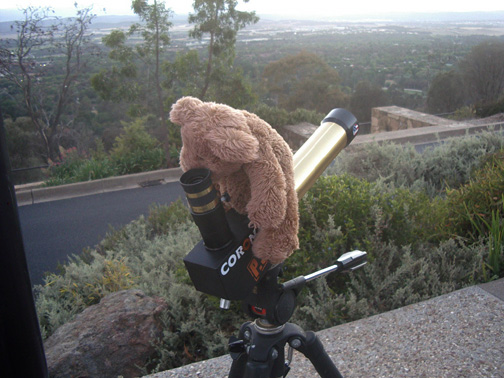
This morning I was up before the Sun. We went to the top of Red Hill to see the Transit of Mercury. This is me using Mummy's Coronado PST. Cloud was a problem but we saw First Contact and about half the transit.
Labels: astronomy, Canberra, telescopes